
Artwork Data
Title
Monument Gandhi (1869-1948) en Nationaal Hindostaans Immigratiemonument
Artist
Year
2004
Material
Brons
Artwork Location
Address
Hobbemaplein, Den Haag
City district
Centrum
GPS data
52.066767793216, 4.2968518784695 View on map
Artwork Description
Text
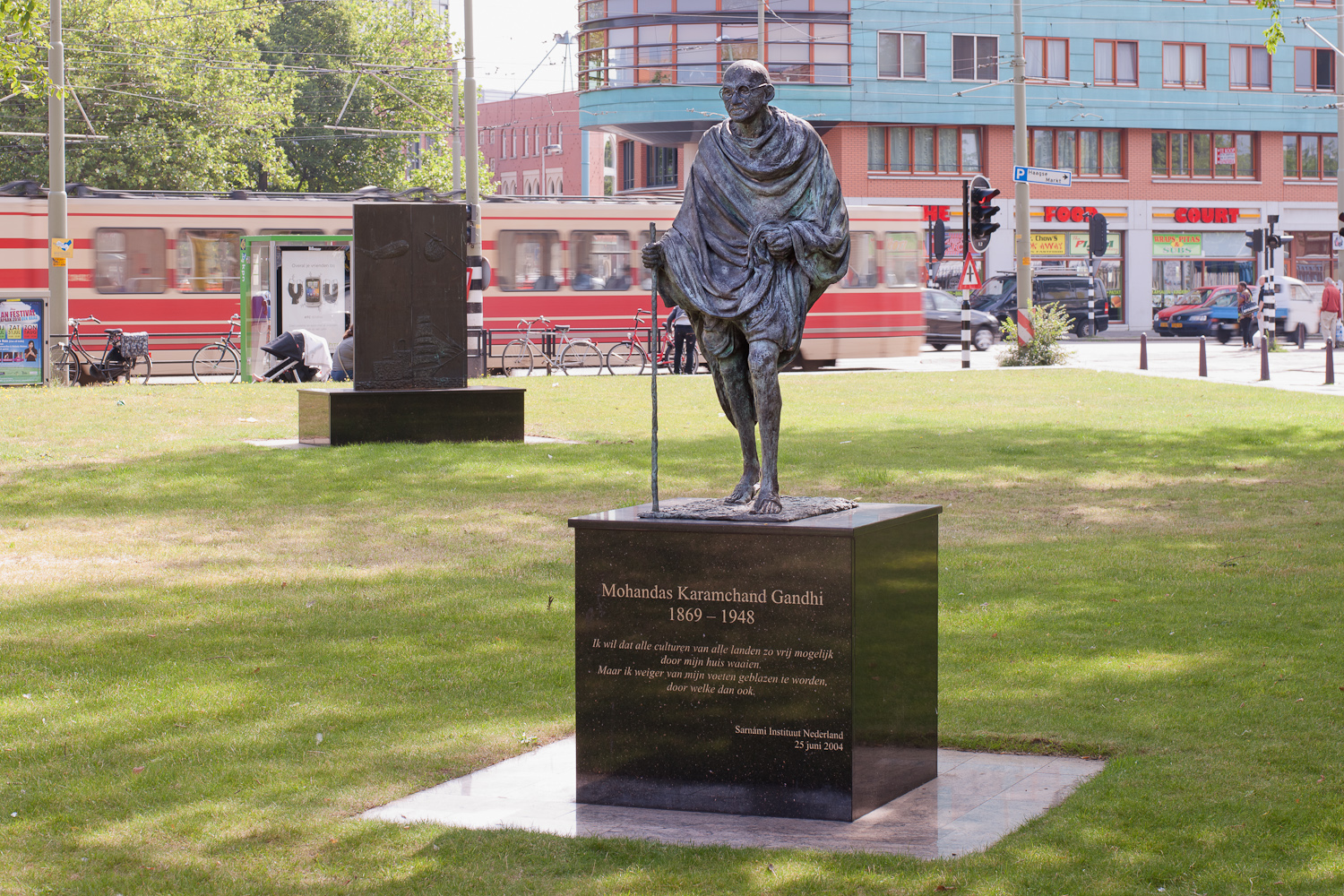
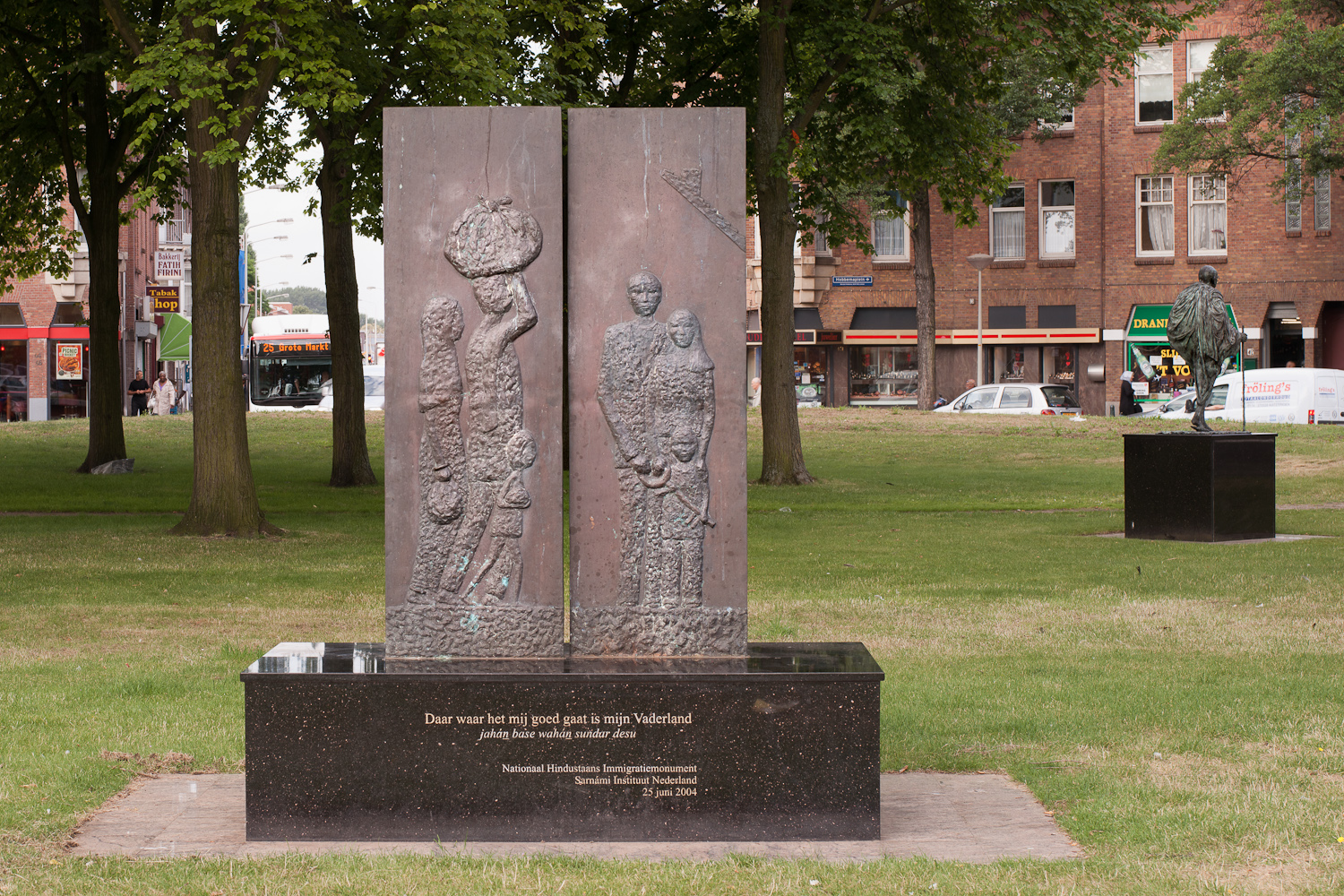
Mahatma Gandhi leading the Salt March. That image had taken root in the mind of sculptor Karel Gomes. And so he depicted this important Indian politician and champion of independence. The Gandhi monument depicts the small, slender Hindustani walking barefoot, draped in a simple cloth and holding his staff in his right hand. This is how he led the peaceful protest march in 1930 against the British monopoly on salt production. Working in a naturalistic style, Gomes has succeeded in portraying both Gandhi’s outward appearance and his inner spirit. Gomes’s Gandhi, with his determined stride, radiates the immense strength of spirit with which he realized many of his ideals. The Immigration Monument by artist Helen Ferdinand depicts immigration in a narrative manner.
In 2004, the Gandhi monument on the Hobbemaplein was unveiled, together with the National Hindustani Immigration Monument. Both memorials are a gift from the Sarnámi Institute Netherlands to the municipality of The Hague. The monuments were erected to commemorate two important moments in Hindustani immigration history. Namely that shortly after 1870, the first groups of Hindustani contract workers were recruited in India, then the British East Indies, to work on Surinamese plantations. And that around Surinam's independence in 1975, many of these workers' descendants came to the Netherlands. Most of them settled in the region of The Hague.
The bronze statue of Gandhi has symbolic significance. Gandhi is regarded as a great source of inspiration for many Hindustani people, both here and in Suriname. By adhering to the core values of “nonviolence,” “truth,” and “solidarity”—which Gandhi strictly upheld—Hindustani people were able to settle into a new environment while preserving their own cultural identity. The monument therefore bears Gandhi’s words: “I want all cultures from all countries to blow through my house as freely as possible. But I refuse to be blown off my feet by any of them.”